
Online Worldwide · Offline Paris | 10년 경력 한국어 교사
실생활 한국어 · Real-Life Korean | Episode 13
"듣다"가 왜 "들어요"가 될까요? — ㄷ 불규칙
Why does "듣다" become "들어요"? — The ㄷ irregular verb
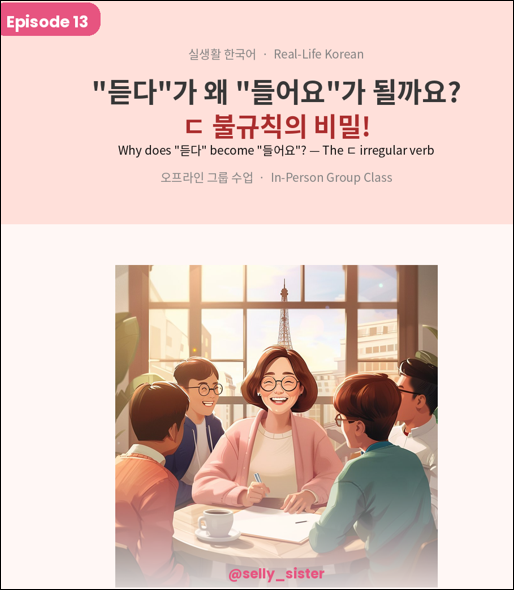
오늘은 베르사유 오프라인 수업이에요.
Today's class is in person — Versailles.
지난 시간에 르 불규칙을 배웠어요.
오늘은 그 다음, ㄷ 불규칙이에요.
Last time we covered the 르 irregular.
Today: the ㄷ irregular.
교실에 모인 학생들 —
Sophie, Lucas, Emma, Hugo, Léa,
Thomas, Camille, Antoine, Chloé, Mathieu.
Ten students gathered in the classroom.
수업 시작 전, Lucas가 먼저 질문을 꺼냈어요 —
Before class started, Lucas had a question ready —
ㄷ irregular: When a verb stem ending in ㄷ is followed by a vowel, ㄷ changes to ㄹ.
듣다 → 들어요 (듣 + 어요 → ㄷ→ㄹ → 들어요)
"듣다" + 어요 → ㄷ changes to ㄹ → "들어요"
묻다 (질문하다, to ask) → ㄷ 불규칙 → 물어요 / 물었어요
"모를 때 선생님한테 물어요." — When I don't know, I ask the teacher.
묻다 (매장하다, to bury) → 규칙 동사 → 묻어요 / 묻었어요
"땅에 묻어요." — I bury it in the ground.
같은 글자지만 뜻에 따라 활용이 달라요!
Same spelling — but the conjugation changes depending on the meaning!
| 기본형 | 활용 형태 | 예문 / Example |
|---|---|---|
| 듣다 🔴 (ㄷ 불규칙) |
들어요 / 들을 때 | 음악을 들어요. I listen to music. 음악을 들을 때 행복해요. I'm happy when I listen to music. |
| 걷다 🔴 (ㄷ 불규칙) |
걸어요 / 걸을 때 | 공원을 걸어요. I walk in the park. 걸을 때 음악을 들어요. I listen to music when I walk. |
| 묻다 🔴 (질문하다) |
물어요 / 물을 때 | 선생님한테 물어요. I ask the teacher. 모를 때 물어봐요. I ask when I don't know. |
| 싣다 🔴 (ㄷ 불규칙) |
실어요 / 실을 때 | 짐을 실어요. I load the luggage. 짐을 실을 때 조심해요. I'm careful when loading. |
| 받다 ⚪ (규칙 동사) |
받아요 / 받을 때 | 선물을 받아요. I receive a gift. 선물을 받을 때 기뻐요. I'm happy when I receive a gift. |
| 믿다 ⚪ (규칙 동사) |
믿어요 / 믿을 때 | 친구를 믿어요. I trust my friend. 친구를 믿을 때 편안해요. I feel at ease when I trust a friend. |
오늘 Lucas는 친구한테 지적을 받았어요.
창피했을 수도 있어요. 하지만 그 실수 덕분에 오늘 수업이 시작됐어요.
그리고 Léa는 아무도 묻지 않은 질문을 했어요.
"묻다"가 두 가지라는 것, 반 전체가 오늘 처음 알았어요. 😊
틀려야 배워요. 그리고 한 명의 질문이 열 명을 가르쳐요.
그게 오프라인 수업의 힘이에요.
Lucas got corrected by a friend — maybe a little embarrassing, but that mistake started today's lesson.
And Léa asked a question nobody else had thought to ask.
The whole class learned something new because of it.
One person's question teaches ten. That's the power of in-person class.
구분 내용
| 🌍 온라인 | Zoom · 전 세계 · En/Fr OK |
| 🗼 오프라인 | 파리 카페 · 스터디룸 |
| ✨ 스타일 | 1:1 · 회화 · K-drama |
| 🎁 무료체험 | 첫 수업 30분 무료 |
📩 수업 문의
📧 sellyjeong802@gmail.com
📱 Instagram @selly_sister
💬 WhatsApp +33 07 68 59 67 47
🟡 KakaoTalk ID - korean_selly